From Phallus to Mother’s Face…From there to…?
First time, I was introduced to Nur Ataibiş’s works at Karşı Sanat, during “The beautiful and supreme from the Classic Age till today” discussions that I conducted along with Bülent Somay and Zeynep Sayın. The relation of the context of this introduction with these works (or with the relationship I have with these works) perhaps is not that coincidental; for during those discussions, we seemed to reach an agreement regarding a concept similar to one where “the supreme” is settled at the focal point of the field of interest and effort of the modern art, differing from classic cultures, which can be “content with” the beauty of appearances, can find comfort in them. We defined “the supreme” as the effect created where some thing (“reality”, “authencity”) which is deemed to be invisible/concealed in principle under the Jewish-Muslim traditions and yet which renders all appearances possible, finds its way into, even threatens, the realm of what are visible.
Despite of the assumptions of a naive empiricism we know for some time that appearances are not the sum of impressions of sensations incited by things--objects informing of themselves directly. We are living as if our lives are defined by a vague order of symbols that are devoid of a subject and as if besieged by fictions that are mostly, that we feel are imposed upon us. “Real”,“another”, “the others” (in the meaning that we once assumed) that urge these fictious meanings, that are within the belief that these fictious meanings should be imposed, are not different subjectivities, which hold their behavioural and perceptional principles within; they too are comprised of fictions that the order of symbols fill the blanks on their behalf. Is there a truth, which carries this sombre emptiness and that is more profound than Is there a truth which carries this sombre emptiness yet is more profound, is there a meaning to this dance of these representations, images, figures that we are tired of watching ?
Perhaps the activity (or “state of spirit”) that we call “modern art” is the name given to the anxiety, plague of continued state of this persistent inquiry of questions that most of us are tired of asking when faced with situations that do not produce answers.
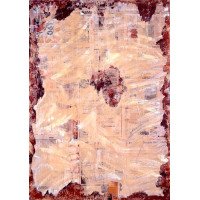
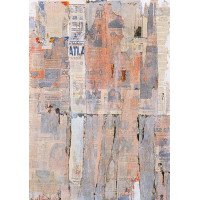
I have mentioned of the “works” of Nur Ataibiş. Perhaps, instead of “works” they should be worded as “traces”. Traces of a quest, that conjures a frantic scraping, the scrape that doesn’t mind leaving its traces behind on the contrary seemed to be expecting something by consciously leaving these traces. A relentless and desperate attempt, which perhaps proves to be in vain at the last analysis, to scrape off the images that seems affixed on us as if trying to define our selves.
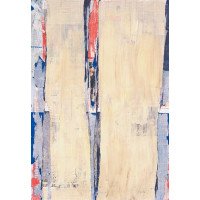
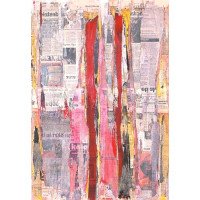
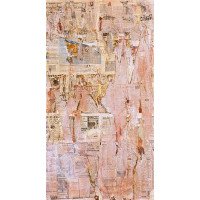
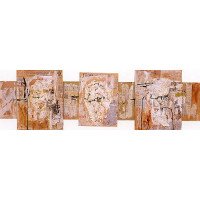
When we view canvases per piece, we realise how fragile and vulnerable, prone to wearing out each and every one of these images, newspaper clippings that have faded away (illegible, perhaps once were about an item of news or an obituary or an engagement), even old diaries, completed or half-way sketched designs and even perhaps love letters that intertwine us to what we are now.
Despite of the fact that they are old, worn out and faded, the order of symbols they devise are absolute; in spite of all the haul energy of scraping mobilised against them, they do not allow some other thing that is structurally different to appear.
In the backdrop of all this scraping, there emerges other newspaper clipping, affairs, identities tickets that are perhaps older yet still lost their lustre.
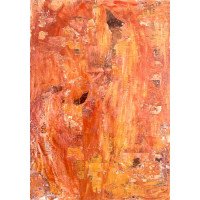
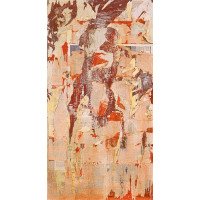
At other canvases we see that instead of scraping, this time the painter attempts painting large “builder” colour stains to embed this pile of images thus nullify its reign. However this way, the applied paint, colour stains do not, cannot give a new, clean and pure surface. The “past” that is strived to be embedded whilst creating perhaps even a more sinister, shivering effect, goes on throwing out images.
“The past” appears to be a concept that is important for Nur Ataibiş’s paintings for more than one aspect; because hers is a task of references, addressings. As she does her best about the power of the descriptive past that she conveys, conveys yet tries to get rid of , she reflects the burden of “the past” over to viewers to feel.
When a question inquiring the reason why he never painted natural figures was addressed, Jackson Pollack that Nur Ataibiş’s paintings do not conceal her relations on technical basis, said “Me Myself is nature”. A statement of self-esteem, an assertion of arrogance that Nur Ataibiş’s paintings do not bear a trace of and hence perhaps that quality is what makes her paintings seem more genuine, more sincere, yet at the same time more dispirited…What emerges in Nur Ataibiş’s paintings is rather than the natural the historic, which means, fictitious and thus (?) a pile of layers that are contrary, alien to the authenticity, essence, reality, if there is such a thing to the “nature” of the subject. However, as what referred here is not the official history, it is not an guiding alternative history that paves the way, a history that is entwined by narratable tales with their heroines and with the heroic resistance movements— a wretched history that is entwined by puny images, whose meaning had been drained, drained off its essence, perhaps never really conveyed any convincing meaning at all…Energy mobilised by these paintings for the sake of struggling with this history makes us forget our innate cynicism (our disheartened and derisive incredulity), urge us to inquire “Could anyone overcome this wreckage (or swamp) of images and reach pure truth ?”
When I consider Nur Ataibiş’s work collectively and classify them in a chronological order, it is enlightening for me to regard them in five sets. When her paintings of the previous exhibition: “Kare (Square)” are considered, the painter still appears to be consumed of traditions and in search of the concept of beauty as “implied” by traditions. (Her relation with Pollack is especially emphasized during this period. However, it appears that traditions seem to be more true to the historical manners rather than primarily, the most famous art work of the last decade, which came out from the States.)
Then in course whatever has happened, the painter regards this tradition as a vice that should be evaded rather than a form of means, even almost (is she carries within herself – by the touch of her hands, the gaze of her looks) began to regard traditions as a dungeon that confines her being. What I have stated so far, what I have referred as the “scraping/embedding” process to be brief, attempts to depict paintings included in this set.
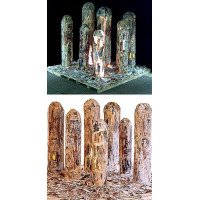
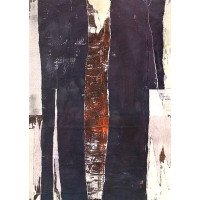
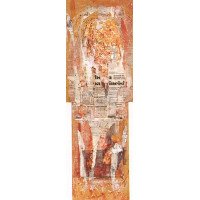
Then there is one piece that stands out amongst all. In this piece, visual material used resembles ones that are used at other pieces to an extent: pale, worn out paintings, newspaper clippings, etc. The distinction lays in the fact that these pale, wretched images are pasted, attached over seven colossal phallic columns that are lit within. When I look at this piece for some reason I recalled what Faulkner said I believe when he was receiving the Nobel prise. In short it meant something like this: In literature (or art in general) there are either cautious failures or magnificent failures…
Despite of its colossal dimensions and the fact that is lit within, the gap between feebleness of the emotional/spiritual effect of their creation and their assertiveness, for some reason or other awakened an emotion similar to misery (self-pity?) in me. In cause a case of failure is in concern perhaps that is involved with the failure of the phallus rather than Nur Ataibiş’s representations of phallus. This ultimate, most material, most bodily substratum almost seems like falling short at conveying, gathering and denoting these images that shape us to what we are now. The phallus that is no longer convincing, that has lost its power, this time became the conveyor of our disintegration, dissipation, vulnerability of our selves.
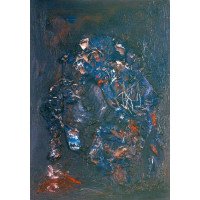
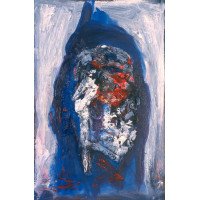
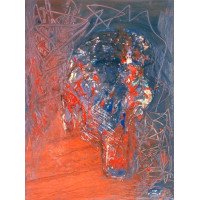
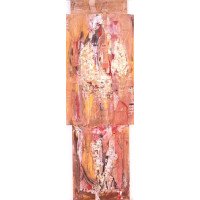
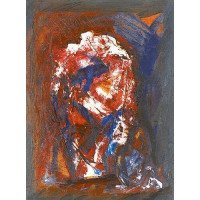
Then there are the portraits. I prefer to think these portraits belong to the one before the last phase of the productivity of Nur Ataibiş in this series: a mansion reached after Phallus…Whose faces are these? Despite of the dispersion and ambiguity of the lines, the figurative relation between different paintings suggests the existence of a single model; a face that only reveals its sexual identity: a woman. Is it the face of the artist or is it the face that the artist looks and sees around, a face of the other that is persistent at repeating itself, a face that is the mother of all other faces…? A face that is incapable of collecting itself, building its self-unity can convey us, even if it would not bear the same meaning that we have expected from Phallus, can it give (once, as Phallus bestowed upon us in course of those days that we were living together) us a similar one and can it save us?
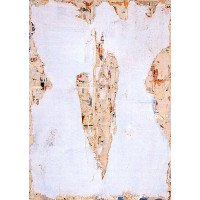
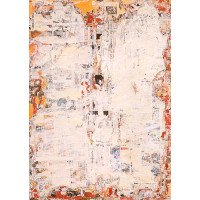
Paintings of the last set show us that the artist would not be settled with these and would not stop here as well. I am afraid that what I can say about these paintings that I didn’t like viewing leave alone “reading”, would be limited to and no matter I like it or not would be resumed to question forms. What we are faced here is a “thing” that turns all colours into plaster white, which we cannot figure whether it is solid or liquid and movements of a fluid “thing”. Why? Is it just to face with the discoloured, amorphous wet clay that we have emerged within (and that we will return, that we have never lost our continuity with), to witness the moments prior and post creation of the shapes? Be it as it may, still why does the artist compels us to go through this confrontation? Is it because we are asked to measure the depth of the despair, which an energy seeking the meaning in a root that lies beyond, behind, and back of the appearances and artificial images will end up? Or, are we expected to see the good news of another thing, if not some new beauty, in these amorphous shapes?
These are the questions that would be left unanswered for now (and I am afraid for a while more)…
İskender Savaşır - 2002